Background
The Food Safety and Standard (Labelling and Display) First Amendment Regulation, 2026 were notified by FSSAI on March 24, 2026 to amend the existing Food Safety And Standards (Labelling And Display) 2020. The Amendment aims to simplify certain labelling requirements while improving clarity and traceability. It introduces relaxations for infant nutrition products and small packages, clarifies the definition of minimally processed foods, and strengthens requirements for non-retail containers and certain food declarations. Importantly, although notified in 2026, the amendment is scheduled to come into force from July 1, 2027.
The Food Safety and Standards (Advertising and Claims) Regulations, 2018 form an important part of the broader labelling framework. These Regulations regulate nutritional, health and other claims made on food labels and in advertisements. They require claims to be truthful, scientifically substantiated and not misleading, and restrict exaggerated or deceptive representations regarding the benefits or characteristics of food products.
New Labelling Rules
- Relaxation for Infant Nutrition Products - The amendment removes the requirement for certain infant nutrition products to declare the percentage contribution to RDA per serving and the number of servings per pack, simplifying compliance.
- Definition of Minimally Processed Foods - It provides a clearer definition of minimally processed foods, including cereals, pulses, fruits, vegetables, and single-ingredient products. Processes such as cleaning, grinding, freezing, fermentation and pasteurization are permitted where they do not significantly alter nutritional value.
- Exemption for Small Packages - Packages with a surface area of up to 100 cm² are exempt from displaying the FSSAI logo. However, the required information must be provided on multi-unit packs.
- Requirements for Non-Retail Containers - Non-retail containers must carry essential details such as the product name, licence number, batch details and manufacturer information. Where space is limited, some information may be provided through accompanying documents, while maintaining traceability.
- Identification of Non-Retail Packs - Such containers must be clearly marked “Non-Retail Container,” “Not for Direct Sale to Consumer,” or with another clear indication to prevent their sale directly to consumers.
- Improved Labelling Standards - Mandatory information must be clear, visible, legible, durable, and tamper-evident, and placed where it can be easily noticed during normal handling.
- Fortification Labelling - Fortified foods must state “Fortified with” followed by the relevant nutrient and display the prescribed fortification logo. The tagline “Sampoorna Poshan Swasth Jeevan” may also be used.
- Artificial Sweeteners and Advertising - Products containing specified artificial sweeteners must carry prescribed warnings for phenylketonurics, children, and pregnant or lactating women. Pan masala advertisements must also display or communicate the required warning clearly.
Overall, the amendment simplifies compliance, improves labelling clarity, strengthens traceability requirements, and enhances consumer awareness and protection.
Emerging Development
In February 2026, the Supreme Court of India asked the Central Government to consider introducing Front-of-Pack Nutrition Labelling (FOPNL) for packaged foods. Following the Court’s directions, FSSAI proposed a red hexagonal warning label 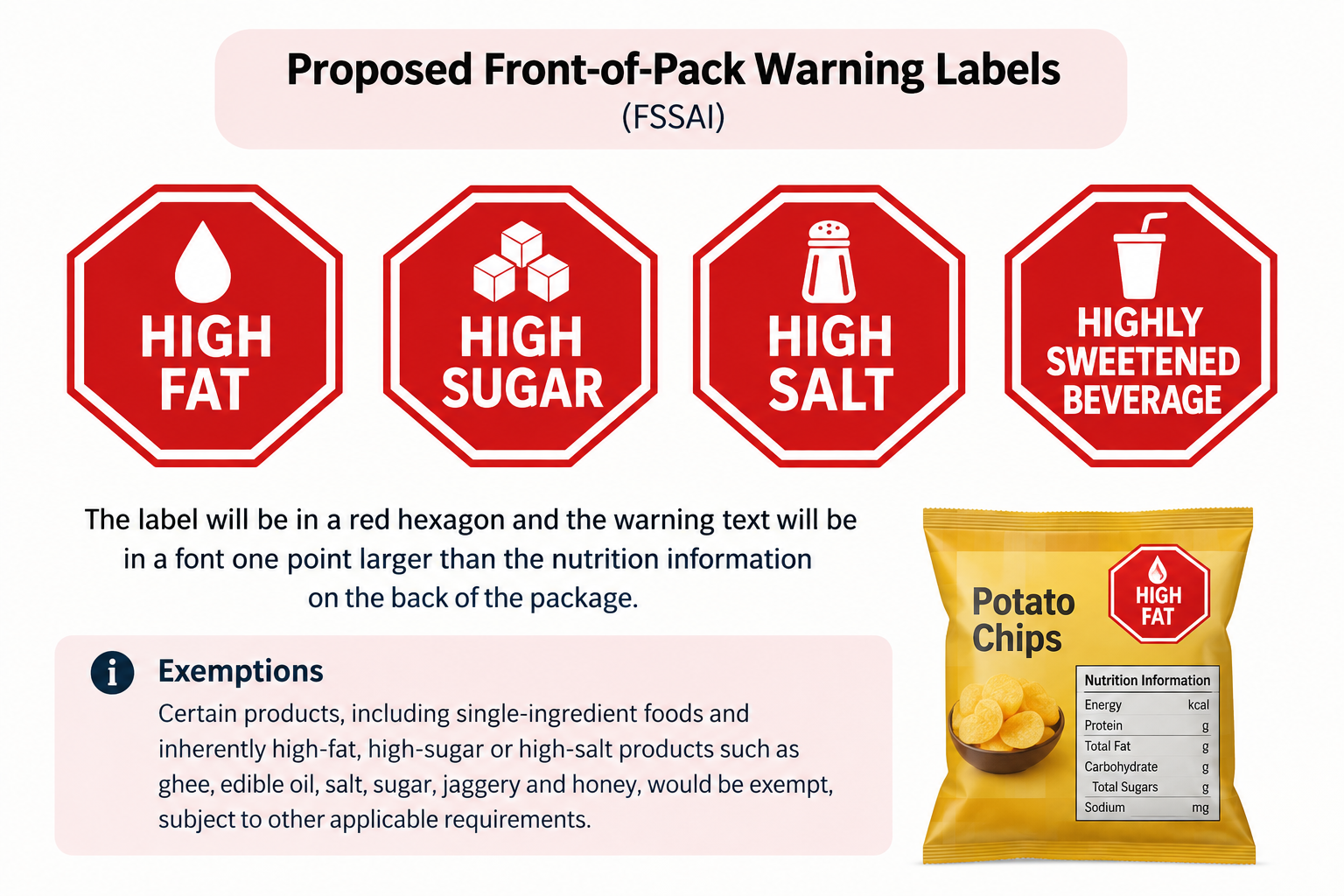 cts high in specified nutrients of concernients of concern (e.g., added saturated fat, sugar, and salt). As stated in FSSAI’s compliance affidavit filed in August 2026, the proposal would be implemented in two phases. In the first phase, products high in at least two specified nutrients would carry the warning; in the second phase, the requirement would extend to products high in even one nutrient. The thresholds would be based on the Dietary Guidelines for Indians, 2024, issued by ICMR-NIN.
The proposed label would indicate warnings such as “high fat,” “high sugar,” “high salt,” or “highly sweetened beverage”, as applicable, in a font one point larger than the nutrition information on the back of the package. Certain products, including single-ingredient foods and inherently high-fat, high-sugar or high-salt products such as ghee, edible oil, salt, sugar, jaggery and honey, would be exempt, subject to other applicable requirements. The proposal aims to help consumers make informed food choices while giving the industry time for reformulation. At the August 23, 2026, hearing, the Supreme Court rejected the argument that international-style labelling would unfairly affect traditional Indian foods and emphasized the constitutional right to health under Article 21 and the State’s public-health duty under Article 47 of the Constitution.
In Supreme court latest order dated 10 September 2026 in 3S And Our Health Society v. Union of India & Anr. the Supreme Court examined FSSAI’s proposed red hexagonal Front-of-Package Warning Label (FoPL) for foods high in fat, sugar and salt. While appreciating the proposal, the Court sought clarification on several aspects, including the two-phase implementation, nutrient thresholds, use of added sugar/fat, treatment of trans fat, and the size, placement and font of the warning label. It also questioned whether pictorial warnings and separate symbols for different nutrients would make the labels more effective and accessible to consumers.
The Court further raised concerns regarding the possible association of red with non-vegetarian food labelling, increased use of artificial additives, and the need for nutrition education in schools. FSSAI has been directed to file a further affidavit addressing these issues within 10 days with the matter next listed on 28 September 2026.
Key Compliance Lessons for Companies and Brands
- Review labelling requirements: As this is a developing story, brands may need to regularly check updated FSSAI requirements and ensure their packaging reflects the latest rules.
- Ensure clear and accurate information: Mandatory declarations must be visible, legible and consistent with the actual product.
- Maintain traceability: Non-retail products should be properly identified and supported by accurate batch, license and manufacturer details.
- Plan packaging carefully: Businesses should consider requirements for small packages, fortified foods and products containing artificial sweeteners during the packaging and product-development stage.
3S & Our Health Society v. Union of India, 2026 SCC OnLine SC 1819
https://www.scconline.com

/Passle/5ca769f7abdfe80aa08edc04/SearchServiceImages/2026-10-13-08-26-45-816-6acdeb455011758bb0c12230.jpg)