

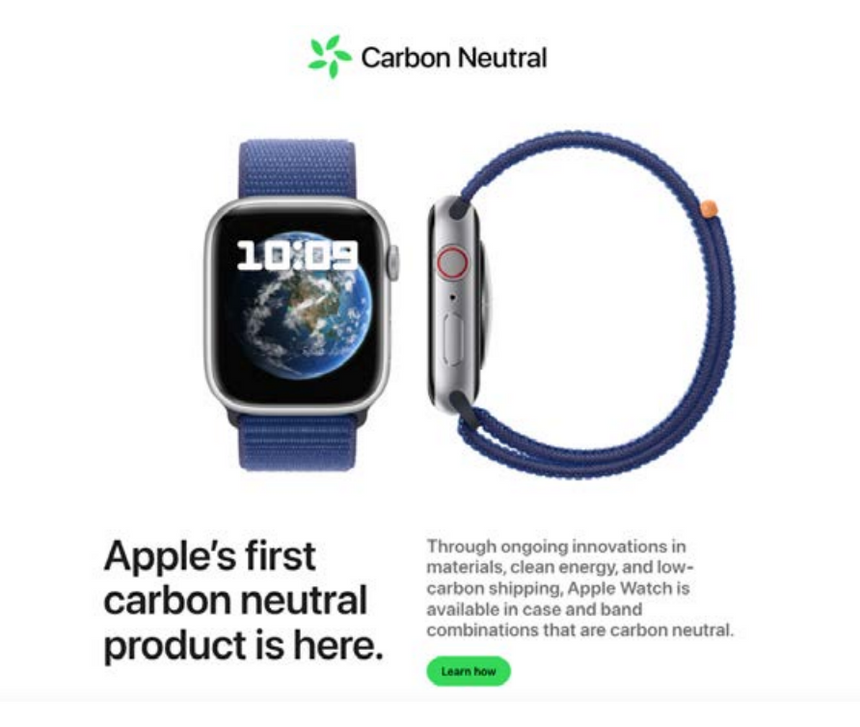
Apple promotes the fact that some of its watches are “carbon neutral.” Some consumers sued, alleging that the claim is false and misleading because the watches are not, in fact, carbon neutral. A federal court in California dismissed the case. Here's why.
In order to properly state a claim for false advertising under California law, a plaintiff must sufficiently allege that a company has acted deceptively. Whether a particular advertisement is deceptive or misleading is judged from the perspective of a “reasonable consumer." In order to satisfy the reasonable consumer standard, a plaintiff must show that a significant portion of the general consuming public or of targeted consumers, acting reasonably in the circumstances, could be misled. In other words, does the advertising have a meaningful capacity to deceive consumers?
Here, the plaintiffs had two theories for why Apple's “carbon neutral” claim was false and misleading.
First, the plaintiffs argued that Apple had failed to purchase sufficient carbon offsets to account for the greenhouse gases generated through the production of Apple watches. The court didn't buy this argument, however, because the plaintiffs didn't know how many watches Apple had actually sold. The court explained, “Every layer of Plaintiffs' allegations about Apple's sales of Apple Watches are based on unsubstantiated assumptions . . . . Plaintiffs' offer nothing other than conclusory allegations that Apple incorrectly calculated the number of carbon credits it should have retired to offset the carbon neutral Apple Watches it sold in 2024.” In other words, if you don't know the facts, how can you argue that the facts are wrong?
Second, the plaintiffs argued that Apple's representations of carbon neutrality are false and deceptive because the carbon credits Apple that purchased were inflated or miscalculated the actual amount of carbon removed from the atmosphere. Apparently, the plaintiffs came to this conclusion based on an analysis conducted by their lawyers. The court didn't think this was sufficient, however. The court wrote, “No scientist, expert, scientific organization, environmental organization, or government agency is referenced in the ‘analysis’ proffered by Plaintiffs . . . . Plaintiffs failed to allege that the methodology underlying their work is accepted in any scientific circles, or that anyone else – scientist or otherwise – has endorsed the accuracy of their work."
Interestingly, the court pointed to the Green Guides as further support for its dismissal of the case. Noting that the Green Guides require that advertisers have a “reasonable basis” for their claims, the court said that it didn't think, here, that the plaintiffs had a reasonable basis to object to Apple's claims.
/Passle/5ca769f7abdfe80aa08edc04/SearchServiceImages/2026-09-16-20-14-48-193-6aaaf8b8cc107f79d317601b.jpg)

/Passle/5ca769f7abdfe80aa08edc04/SearchServiceImages/2026-09-16-19-58-01-848-6aaaf4c9cc107f79d31752ef.jpg)