

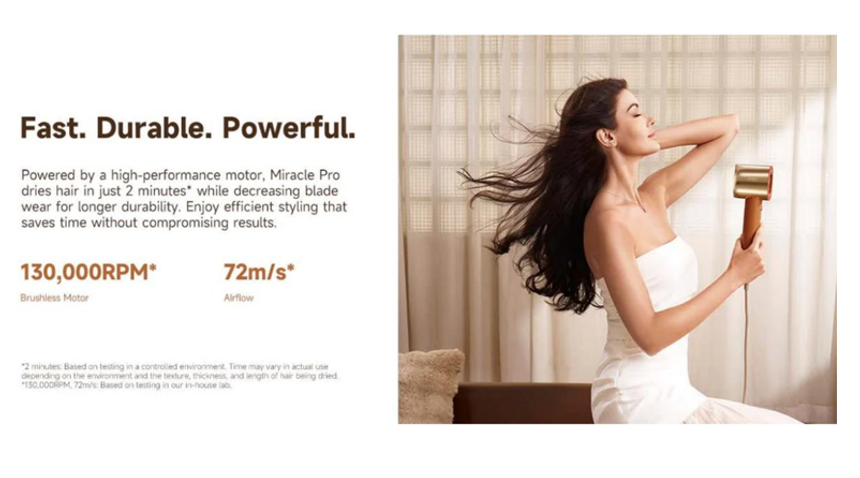
Dreame Technology advertised a hair styler and a hair dryer that could dry shoulder-length hair in two minutes. Dyson, a competitor, challenged Dreame's advertising at the National Advertising Division. Dyson argued that the advertising was misleading because it included images of models, drying their hair, who had much longer than shoulder length hair. In other words, regardless of the express claims that Dreame made, the advertising conveys the message that the company's products dry longer hair in two minutes as well.
Consistent with ordinary advertising law principles, at the NAD, advertisers are responsible for substantiating all of the claims that are reasonably communicated by their advertising. As the NAD explained, “In analyzing the messages conveyed by a particular advertisement, NAD typically reviews the net impression created by an advertisement as a whole, not merely words or phrases standing alone, and taking into consideration both the words and the visual images.”
Looking at the challenged advertising here, the NAD found that one reasonable takeaway was that Dreame's product could dry longer hair in two minutes as well – regardless of the claims or disclosures that had accompanied the images.
Significantly, the NAD emphasized that this problem couldn't be solved by a disclosure. The NAD explained, “It is also well-settled that a disclosure cannot contradict or be used to cure an unsupported message. Here, no disclosure can cure the message that the products can dry longer hair in two minutes.”
Speaking of reasonable takeaways, here are two important takeaways from this decision that all advertisers should keep in mind.
First, while clear and conspicuous disclosures can be used to help qualify claims, a disclosure can't be used to contradict the main message of the advertising.
Second, when you've got powerful imagery in advertising, it's important to pay attention to what those pictures are communicating. And, if there's a possibility that the imagery communicates misleading claims, don't count on disclaimers – or even prominent copy – to clear up the confusion.
Dyson v. Dreame Technology, NAD Fast-Track SWIFT Case #7600 (08/07/2026).

/Passle/5ca769f7abdfe80aa08edc04/SearchServiceImages/2026-09-16-19-58-01-848-6aaaf4c9cc107f79d31752ef.jpg)
/Passle/5ca769f7abdfe80aa08edc04/SearchServiceImages/2026-10-05-14-47-21-387-6ac3b8797533beb6e63d92a5.jpg)
/Passle/5ca769f7abdfe80aa08edc04/SearchServiceImages/2026-09-16-19-53-14-993-6aaaf3aacc107f79d3174f13.jpg)