The European Advertising Standards Alliance just announced the publication of its Guide on Disclosing Ads Generated or Enhanced by Artificial Intelligence, which is intended to provide “advertising self-regulator organizations and the wider advertising ecosystem with a common framework for approaching AI transparency in commercial communications.”
Emphasizing that disclosure of AI use does not replace the fundamental requirement that must never mislead consumers, EASA said that its guidance stands for the principle that “AI transparency should be meaningful and proportionate.”
In announcing the release of the guidance, Ludovic Basset, the Director General of EASA, said, “With this Guide, the European advertising self-regulatory network is translating broad principles into an advertising-specific framework. It demonstrates precisely where self-regulation adds value: responding quickly to technological change, complementing regulation, and turning principles into practical solutions.”
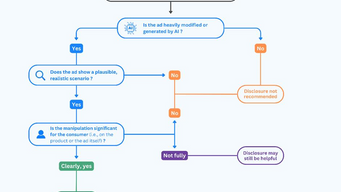
EASA's guidance focuses on the use of three principles in order to determine whether disclosure is necessary in connection with the use of AI-generated content in advertising
Level of AI Use
The first principle is whether the advertising was fully generated or heavily enhanced by AI tools. If the advertising was almost entirely produced with AI, then disclosure may be required, assuming that the other principles also support the need for disclosure. Ads that include minimal AI enhancements are less likely to require disclosure.
Ad Content's Plausibility or Authenticity
The next principle considers whether the ads show scenes resembling existing people, places, or events that could appear authentic, but which were almost completely generated or edited with AI. In that situation, disclosure is ordinarily recommended. On the other hand, “When ads include fantastical or cartoon elements, behaviors or events that would normally not happen in real life, disclosure is not recommended.”
Significance to or impact on the consumers
The third principle considers the impact of the AI use on the consumer. As the guidance explains, “Even when an ad shows what could falsely appear to be existing real life authentic scenes and was generated entirely with AI, disclosure might still not be recommended if the manipulations do not have significant impact on the consumer.”
The guidance explains that each principle has nuance to it – "and no one principle can ever be sufficient to trigger the recommendation for disclosure." When considering all of the principles together, EASA emphasized that “Disclosure is recommended for heavy AI-enhancements of content resembling a real, existing scenario or product which is significant to the consumer to the extent that they may be mislead into thinking the content is authentic or true.”