


Overview
The Advertising Standards Council of India (ASCI) has released draft guidelines requiring brands to disclose the use of Artificial Intelligence in advertising. The framework is risk-based: it does not ban AI, but it mandates transparency wherever AI-generated content could materially influence consumer decisions. These guidelines align with the Information Technology (Intermediary Guidelines and Digital Media Ethics Code) Amendment Rules 2026 and operate alongside the existing ASCI Code, which continues to apply in full. The draft is open for public consultation until 13 June 2026.
The Core Compliance Question
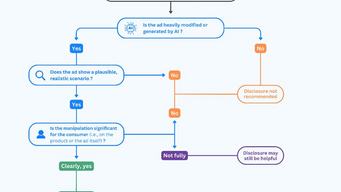
ASCI asks two questions to determine whether your AI use requires a label:
- Does the AI use mislead consumers about a product’s claims, performance, or benefits, particularly where it is central to the ad’s persuasive message or materially influences purchase decisions?
- Would the absence of a disclosure create a false or misleading impression of the product’s claims or benefits?
If the answer to either question is yes, a disclosure label is mandatory.
Three-Tier Risk Classification: What You Need to Do
The guidelines divide AI use into three risk categories:
Risk Level | Obligation | Examples | Action Required |
|---|---|---|---|
High Risk | Prohibited: disclosure label does not cure non-compliance | Deepfakes; fabricated endorsements/testimonials; exaggerated product results; fake locations presented as real; using a person’s likeness or voice without consent; AI-generated fake authority figures (e.g. a fictitious doctor promoting a supplement) | Stop immediately. These violate the ASCI Code regardless of whether you add an AI label. Review all existing campaigns for these elements. |
Medium Risk | Mandatory disclosure label required | Virtual/synthetic influencers; replicating a real person’s likeness or voice (even with consent) for personalised messaging; AI product demonstrations; realistic AI-generated settings or events; 3D renders of products that do not yet exist; AI-generated sound effects central to product claims; AI-powered sponsored product suggestions | Add a clear, prominent label. Acceptable formats include “Audio/Video created using AI” or “Audio/Video enhanced using AI”. Sponsored AI suggestions must be labelled ‘Sponsored by’. Follow ASCI disclaimer guidelines. |
Low Risk | No label required | Colour correction; noise reduction; standard blemish removal; minor lighting tweaks; decorative AI backgrounds; ambient music or jingles unrelated to product claims; fantastical elements audiences clearly recognise as unreal (e.g. dragons); AI-generated ad copy or accessibility descriptions | No action required. Document your AI usage internally to demonstrate proportionate compliance if challenged. |
What You Need to Change
- Audit your current AI usage: Map every use of AI across your advertising production process: visuals, audio, influencers, copy, and testimonials. Classify each use against the three tiers above.
- Remove or restructure high-risk content: Any campaign using deepfakes, fabricated endorsements, unauthorised likenesses, or fake authority figures must be withdrawn or restructured. An AI label will not make these compliant.
- Label medium-risk content prominently: Disclosures must be obvious, noticeable, and understandable, not buried in fine print. ASCI has not specified a single mandatory label format; brands may use “Audio/Video created using AI” or “Audio/Video enhanced using AI” or any other label that accurately informs the consumer. The label must follow ASCI’s disclaimer guidelines where applicable.
- Check consent for likeness and voice replication: Even where a celebrity or person has given consent for their likeness or voice to be replicated by AI, the resulting content still falls in the medium-risk category and requires mandatory disclosure. Consent does not remove the labelling obligation.
- Review AI-powered paid suggestions: If your platform or campaign uses AI to generate paid or sponsored product recommendations, these must be specifically labelled as ‘Sponsored by’; a general AI label is not sufficient.
The Cost of Non-Compliance
Non-compliance carries both regulatory and commercial consequences:
- ASCI Code violations, including withdrawal or modification of prohibited content apply to high-risk AI use irrespective of whether a label is present.
- Reputation Risk: Consumer trust is the explicit concern behind these guidelines. Brands found to be deploying synthetic influencers, deepfakes, or fabricated testimonials without disclosure face significant reputational damage amongst an increasingly AI-literate public.
- Personality Rights Exposure: Using a person’s likeness or voice without consent, or deploying deepfakes, exposes brands to claims under personality and publicity rights, independent of the ASCI framework.
- Downstream Liability: while the draft does not yet set out a comprehensive liability regime for data usage or deepfake harms, it is explicitly acknowledged as an area for further development. Brands acting in breach now risk being on the wrong side of a stricter future framework.

/Passle/5ca769f7abdfe80aa08edc04/SearchServiceImages/2026-10-13-08-26-45-816-6acdeb455011758bb0c12230.jpg)