The phrase "clinically proven" is one of the most powerful claims in a beauty marketer's ‘Arsenal’*. It sounds scientific, authoritative, and reassuring. But in a ruling published in April 2026, the Advertising Standards Authority made clear that brands invoking those words must back them up with robust evidence. Claims which are capable of objective substantiation must be substantiated with objective, not subjective evidence. Two further rulings published in April and May 2026 indicate a consistent approach by the ASA.
In the health and beauty sector ‘robust evidence’ means experimental human studies, i.e. ‘clinical trials’. These are the gold standard for objective substantiation. They comprise rigorously controlled trials in humans where an intervention group uses the product, and a control group uses a placebo. They are typically double-blind, where neither the subjects nor the researchers know who is in which group, minimizing bias. In recent years, however, we’ve seen a trend towards brands using the claim ‘clinical proven’ when their substantiation only consists of Consumer Use Tests, such as 8 out of 10 owners said their cats preferred it (albeit in relation to cat food, not a feline face cream). For some kinds of claims, such as those concerning visible improvements, CUT data is fine as substantiation, but traditionally we would have advised that a Consumer Use Test is not ‘clinical’ proof. These decisions represent the ASA reimposing that policy.
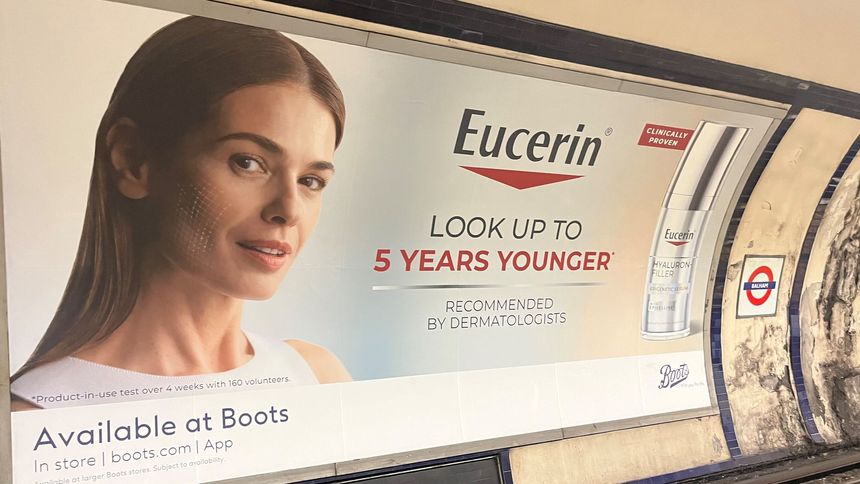
The leading ruling concerned an ad by Beiersdorf, advertising its Eucerin Hyaluron-Filler Epigenetic Serum on a poster at Balham Underground station. The ASA upheld the complaint and found the ad to be misleading.
What Went Wrong?
Beiersdorf had evidence, but it was not good enough to justify a "clinically proven" claim.
Beiersdorf's poster featured the headline "LOOK UP TO 5 YEARS YOUNGER" alongside the words "CLINICALLY PROVEN". The principal study involved 160 participants asked whether they thought they looked younger after four weeks, but it had no control group, no clear blinding methodology, no standardised application protocol, and relied entirely on subjective self-assessment. In other words, it was a Consumer Use Test. The ASA concluded that self-reported results were “not sufficiently robust to substantiate a clinically proven claim.” The remaining studies fared no better: one showed only a one-year reduction in biological skin age rather than the five years claimed, another included no measurement to quantify the anti-ageing effect, and the peer-reviewed paper did not test the actual product.
The UK Relevance Problem
A notable thread running through these rulings is the ASA's increasing focus on whether trial conditions are representative of typical UK consumers. In the Beiersdorf case, the trial was conducted in a country with a hotter, sunnier climate than the UK, with different participant skin types, and the ASA considered these differences "may reduce the extent to which the results could be taken as directly representative of typical use by UK consumers in everyday conditions".
This is a significant development, although once again, the policy is not entirely new. It is more of a restatement of the previous policy. Brands substantiating a "clinically proven" claim for the UK market using a trial conducted abroad now need to consider carefully whether the trial population and conditions are sufficiently representative of British consumers.
What does the ASA now expect?
Reading this ruling, a clear picture emerges of the ASA's requirements:
- Self-reported, subjective results are not enough, even if agreement levels are high.
- A control group is required; studies without one are treated with considerable scepticism.
- Sample sizes must be adequate and ideally justified.
- Study methodology must be transparent and rigorous, including proper blinding, randomisation, and standardised protocols.
- The evidence must match the specific claim; a study on an active ingredient is not a study on the finished product.
- Finally, trial conditions must be relevant to UK consumers.
What does this mean for brands?
For in-house counsel advising brand teams, the practical takeaway is straightforward: audit your "clinically proven" claims now, before the ASA does it for you. These rulings suggest the ASA is taking a tighter approach than some in the industry may have been accustomed to in recent years. Self-assessment studies, long a staple of the beauty industry's evidence base, are clearly no longer sufficient on their own to support a "clinically proven" claim.
All three rulings resulted from complaints, not proactive ASA monitoring. Given that the ASA is increasingly deploying AI to monitor advertising, more proactive scrutiny by the regulator can be expected in this area. Brands making "clinically proven" claims based on evidence resembling the consumer use tests in these rulings would be well advised to either upgrade the evidence or downgrade the claim. The phrase carries an implicit promise of scientific rigour, and the ASA is now holding brands to that promise.
*Don’t mention the Champions League Final. I mentioned it once, but I think I got away with it.

/Passle/5ca769f7abdfe80aa08edc04/SearchServiceImages/2026-09-16-20-14-48-193-6aaaf8b8cc107f79d317601b.jpg)