Chris Packham is not a man known for backing down from a fight. Whether it's badgers, bird of prey persecution, or the BBC's scheduling decisions, the wildlife presenter has a track record of picking battles and winning them. So when he turned his binoculars on the Agriculture and Horticulture Development Board's "Let's Eat Balanced" campaign, you'd have been wise to put your money on Packham rather than the quango.
On 13 May 2026, the ASA published its sprawling ruling on a complaint by Packham against AHDB's multi-platform campaign promoting British beef, lamb, and dairy. The campaign comprised three TV ads, two national press ads, a website page, and an Instagram post — seven ads in total, seen between September 2024 and February 2025. Three issues were investigated: first, whether the ads misleadingly omitted information about the environmental impact of meat and dairy; second, whether carbon footprint comparison claims in two press ads were misleading and unsubstantiated; and third, whether certain ads misleadingly implied that British cows were typically outdoor-grazed.
The good news for AHDB is that the complaints about two of the three issues were not upheld. On Issue 1, the ASA accepted that the TV ads and other materials were primarily about provenance and nutrition, and that consumers would understand images of green fields as a "generic indication" of British rural origins, rather than an environmental claim. On Issue 3, the ASA found that imagery of cows in pastures reflected the reality that most UK cattle have at least some outdoor access, and was unlikely to mislead.
But Packham's real prize was Issue 2, and this is where it gets interesting for brand-owners making environmental claims.
The carbon footprint claims
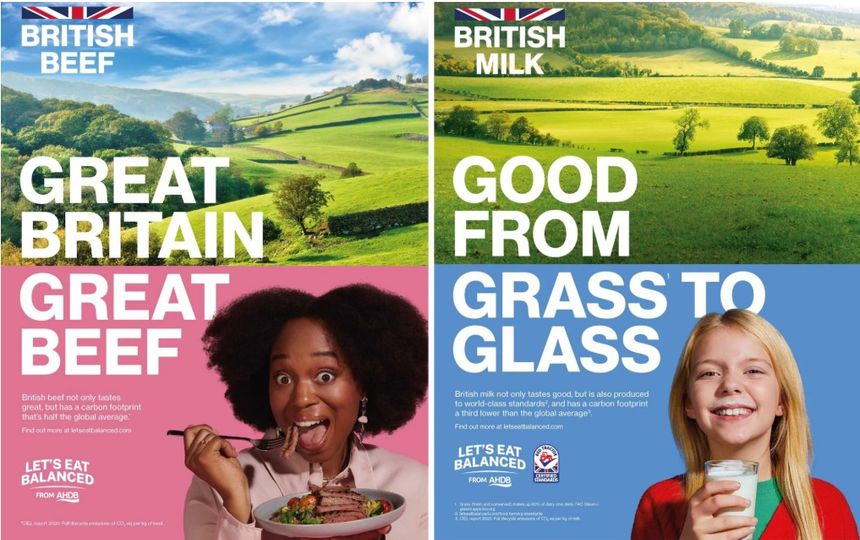
The two national press ads, one for beef and the other for milk, each featured idyllic rural imagery and headline claims comparing British produce favourably to the global average. The beef ad stated that British beef "has a carbon footprint that's half the global average". The milk ad claimed British milk "has a carbon footprint a third lower than the global average". Both included a footnote reading "Full lifecycle emissions of CO2 eq per kg of beef/milk".
Here's where AHDB came unstuck. Their substantiation, a meta-analysis and a 2020 report, only covered emissions from "cradle-to-retail": everything from farm inputs to the supermarket shelf. AHDB argued that in agricultural life-cycle assessments, "full life-cycle" means full within that boundary, and that consumers would understand the comparison in those terms.
The ASA was having none of it. They concluded that the average consumer, being "reasonably well-informed, observant and circumspect", would understand "full lifecycle emissions" as extending beyond the retail stage to include post-retail activities such as cooking and food waste. The footnote, far from helping AHDB's case, positively reinforced that interpretation. AHDB produced a consumer survey very late in the investigation, but the ASA noted it was far from conclusive, with sizeable minorities viewing the claims as extending beyond production.
The result? The beef and milk ads both breached various CAP Code rules concerning misleadingness and environmental claims and must not appear again in the same form.
What does this mean for your brand?
The lesson is stark and simple: if you make a comparative environmental claim and use language suggesting a "full" life-cycle assessment, you must either be able to substantiate it across the entire life cycle or make the boundaries of your claim crystal clear. The ASA reminded AHDB that “environmental claims should be based on the full life cycle unless the ad stated otherwise.” A footnote saying "full lifecycle emissions" does not limit your claim, it widens it.
It's also worth noting that AHDB's consumer survey, conducted mid-investigation, did not save them. The ASA reserves the right to reach its own judgment on how the average consumer interprets an ad, regardless of what your research says. So, if your environmental substantiation has a crack in it, don't assume a survey will paper over it.
For those of us who have been watching the ASA's approach to green claims with interest, from airlines to oat milk and now to actual cows, this ruling is another clear signal. Say what you can prove. Prove what you say. And if there's a gap in your data, say so explicitly in the ad, not in a footnote that makes things worse.
As for Chris Packham, he can chalk this up as another victory. The badgers will be thrilled.

/Passle/5ca769f7abdfe80aa08edc04/SearchServiceImages/2026-09-16-20-14-48-193-6aaaf8b8cc107f79d317601b.jpg)